

What if the best Las Vegas itinerary leaves room to do less? The Strip may look compact on a map, but queues, long walks through hotels, and traffic can eat into a packed schedule. You’re right to want the big sights, a good meal, and a show without turning three days into a race.
This practical three-day plan groups activities by location and pace, so you spend less time doubling back and more time enjoying the city. It balances headline attractions with breaks, meals, and room to adjust when plans change. You’ll also find guidance on what to book ahead and what to leave flexible.
Start with major Strip sights, set aside time for Downtown, then choose an evening experience that suits your energy and budget. Use the daily outline as a framework, not a minute-by-minute script. Check current hours and schedules before you go, and resist the urge to add every tempting stop. A few well-chosen plans usually make for a better trip than an overbooked checklist.
Key Takeaways
- Build your las vegas itinerary around a few priorities, realistic travel time, and breaks rather than trying to fit in every attraction.
- Use the three-day plan to group nearby Strip sights, then choose optional stops that match your pace and interests.
- Adjust the plan for a shorter or longer stay by deciding what to keep, skip, or add before you book.
- Map each day, check current opening times, and schedule timed bookings before filling gaps with flexible activities.
- Use the VegasWizzard Las Vegas Travel Guide to explore curated recommendations, and consider a show, tour, or day trip that fits your plans.
What Makes a Las Vegas Itinerary Realistic for Your Trip?
Build your plan around priorities, realistic travel time, and room to rest. A useful las vegas itinerary isn’t a race to collect every attraction. Give each day a clear purpose, then leave enough space for meals, transfers, queues, and a change of pace.
Treat any sample plan as a framework, not a schedule you must copy. Your ideal mix depends on what you enjoy: shows, sightseeing, food, outdoor experiences, or a little of each. Las Vegas also has a broader story beyond its famous resort corridor. For context on the city’s history, economy, tourism, and attractions, see this History and Overview of Las Vegas.
A realistic day has a few anchor activities, not a new commitment in every time slot. For example, plan one major sightseeing stop, a meal nearby, and an evening show, with a rest break between them. That structure protects the experiences you care about without letting a late start or a long queue derail the whole day.
Choose your trip anchors before filling the day
Pick one main experience for each day before adding extras. It could be a show, a stretch of Strip sightseeing, a food-focused outing, or time outdoors. Then sort your ideas into two groups: must-dos and nice-to-haves. When time runs short, you’ll know what to cut without second-guessing the whole plan.
Choose anchors based on your interests, not just what appears on a top-attractions list. If a show matters most, plan the day around its start time. If exploring is the priority, choose a sightseeing focus and let optional stops fill the gaps.
Build a pace that leaves room for Las Vegas logistics
Allow time for walking, queues, meals, and getting between stops. Two places can look close on a map yet take longer to reach than expected once you account for large properties, crossings, or waiting. Grouping nearby activities cuts wasted travel time and gives more of the day back to you.
Avoid stacking timed bookings in distant parts of town. Put the fixed commitment first, then choose nearby activities around it. Check current opening times and event schedules before setting the order, since access and hours can affect what fits. Leave one flexible block for a proper rest, an unplanned meal, or a spontaneous stop. If the day runs smoothly, use that space. If it doesn’t, you won’t need to scramble.
- Anchor each day around one priority.
- Group nearby stops before adding optional detours.
- Keep at least one block open instead of booking every hour.
A Flexible 3-Day Las Vegas Itinerary, Day by Day
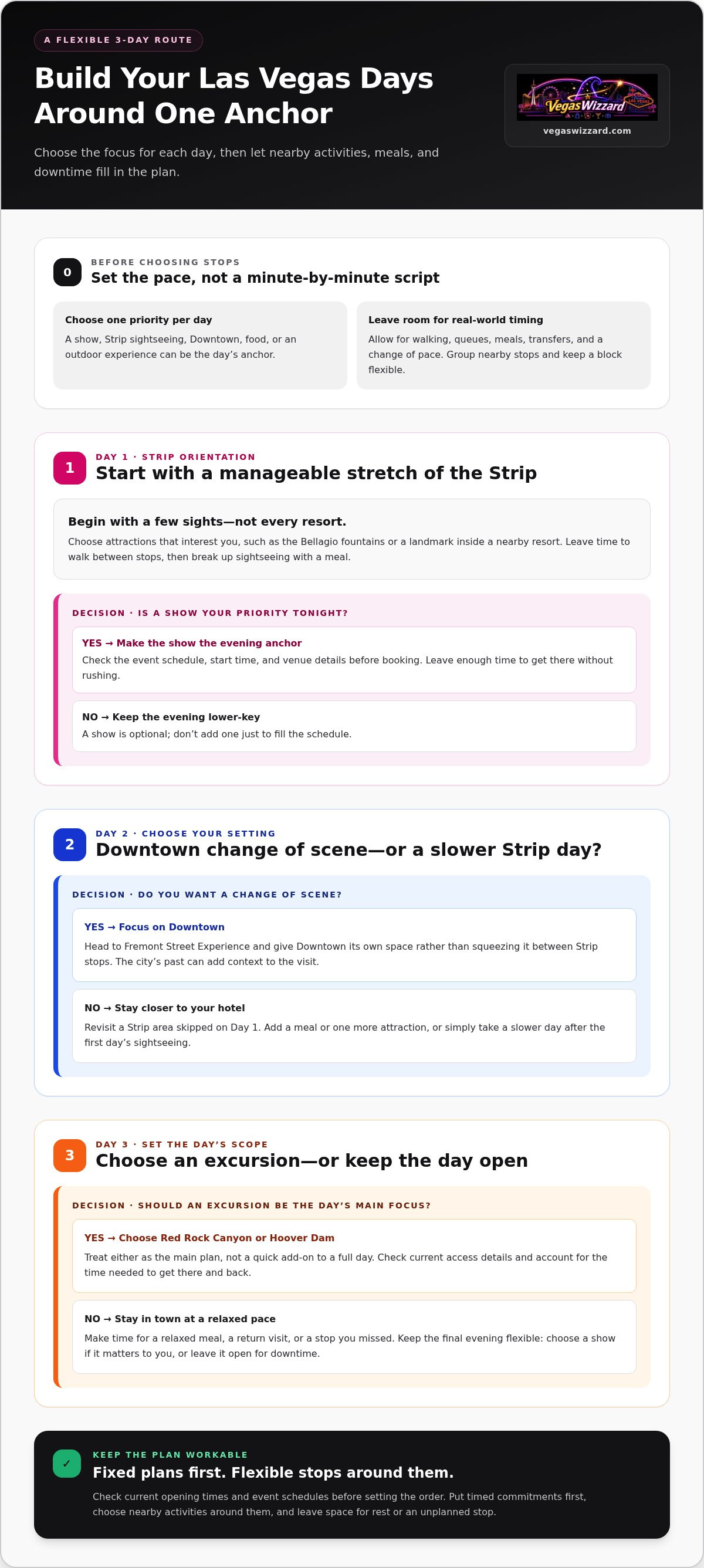
Use this three-day outline as a starting point, not a checklist. For a ready-made version, see the Las Vegas 3-day itinerary. Keep the Strip and its nearby sights together, then give Downtown or an excursion its own space. That way, you’re not crossing town between every stop. Choose one daily anchor, then build nearby activities and downtime around it.
- Day 1: Get oriented and explore the Strip. Start with a manageable section of the Strip rather than trying to visit every resort. Pick a few sights that interest you, such as the Bellagio fountains or a landmark inside a nearby resort, and leave time to walk between them. The goal is to get your bearings, not cover the full corridor on foot.
Break up the sightseeing with a meal, then decide whether you want an evening show or something lower-key. A show can be the day’s main event, but it doesn’t have to be a compulsory extra. Check the event schedule, start time, and venue details before booking, and leave enough room to get there without rushing.
- Day 2: Choose Downtown or a slower Strip day. For a change of scene, head to Fremont Street Experience and focus on Downtown rather than squeezing it between Strip stops. The city’s past can add useful context to your visit. The University of Nevada, Las Vegas offers a Historical Context of Las Vegas perspective on its development.
If Downtown isn’t a priority, stay closer to your hotel and revisit a Strip area you skipped on Day 1. Add a meal or one more attraction, but don’t treat a quieter day as a planning failure. A slower pace can be the sensible choice after a full first day.
- Day 3: Pick an excursion or keep the day open. Red Rock Canyon or Hoover Dam can make a worthwhile change from resort areas, but treat either as the day’s main focus, not a quick add-on to an already full schedule. Check current access details and account for the time needed to get there and back before making plans.
If you’d rather stay in town, use the day for a relaxed meal, a return visit, or a stop you missed. Keep the final evening flexible: book a show if that’s a priority, or leave it open for downtime. For help comparing itinerary ideas and bookable experiences, explore the VegasWizzard Las Vegas travel guide.
Las Vegas Itineraries for Two, Four, or More Days
Use your trip length to decide what belongs on the schedule and what can go. A las vegas itinerary shouldn’t become a longer checklist just because you have another night. For a ready-made longer plan, see the ultimate 5-day Las Vegas itinerary. Keep the experiences that matter, cut detours that don’t fit your interests, and use extra time to slow the pace or explore a different side of the city.
| Trip length | Keep | Cut or add |
|---|---|---|
| Two days | One Strip-focused block, one evening experience, and one personal-interest activity. | Cut distant optional stops. Choose either a longer excursion or more time in the city. |
| Three days | The core Strip day, a Downtown or city-focused day, and a day for a chosen excursion or slower plans. | Keep optional stops flexible rather than packing every gap. |
| Four days | Your three-day priorities, with a separate day for an excursion or a slower, interest-led plan. | Add more dining time, another show, or an open recovery block. |
| Five or more days | The experiences you care about most, with space to revisit favorites. | Add personal interests instead of repeating standard sightseeing by default. |
What should you keep in a two-day itinerary?
Protect one Strip-focused block and one experience that feels personal to you. That could be a show, a food outing, or a sightseeing stop you’ve been looking forward to. Then choose one additional interest that fits without turning the day into a transfer marathon. If an excursion takes a substantial part of the day, give it priority over extra city stops. Otherwise, stay in town and explore at a more comfortable pace.
Cut optional stops that add a long journey but don’t match your priorities. A keep, cut, or save-for-next-time list helps: make it before you arrive, while it’s easier to be objective. For wider context on how tourism and development shape the city, the City of Las Vegas shares information on Las Vegas Economic Development and Tourism.
What can you add when you have four days or more?
Give a day trip its own day instead of wedging it between a full sightseeing schedule. If you’d rather stay in town, make the additional day slower and interest-led. Add a second show, give meals more breathing room, revisit a place you liked, or leave a block open to rest. More time means more choice, not an obligation to fill every hour.
Repeat visitors can skip familiar headline sights and build around what they missed or want to explore more deeply. Choose the extra day based on your interests, whether that means food, entertainment, or an outdoor outing. Before locking in plans, compare travel time and current schedules. An extra booking only adds value if it fits the day without crowding out the reason you came.
How to Make Your Las Vegas Itinerary Work on the Ground
A plan can look tidy on a screen and still fall apart once you’re walking between resorts, waiting for a table, or crossing town for a booking. Make your las vegas itinerary work in this order: map the day, check current opening times, place fixed bookings, then add flexible stops. That sequence protects the commitments that matter without turning every spare minute into another obligation.
- Map the route. Group stops in the same area and note how you’ll get between them.
- Check hours and access. Confirm current attraction details, event schedules, and transport options before settling the plan.
- Place timed bookings. Schedule shows, tours, or other fixed-time activities first.
- Add flexible stops. Fit meals and optional visits around the fixed plans, leaving room for delays.
Sequence stops and bookings to avoid wasted time
Don’t assume two nearby map pins mean a quick transfer. Large properties, walking routes, queues, and venue entry can stretch the gap between stops. Check the route between actual entrances, not just the distance between markers. Avoid crisscrossing town for short visits when you could group those stops into a separate block.
Build around any fixed start time. If you’ve booked an evening show, keep the earlier part of the day nearby or allow enough time to travel, eat, and arrive without rushing. A low-stress itinerary has breathing room between fixed plans, so one queue or slow meal doesn’t throw off the whole day.
Keep transport, weather, and energy in the plan
Choose transport based on the route, not habit. Walking may suit a compact cluster of stops; rideshare, public transit, or a car may make more sense for a longer distance. The Las Vegas Monorail follows a 3.9-mile route along the east side of the Strip, from SAHARA Las Vegas to MGM Grand, so check whether its stations fit your plans rather than assuming it serves every stop. Review current transport details before you head out.
Check the forecast before committing to outdoor plans, then adjust your timing and bring water for the day. If the weather or your energy changes, shorten the route instead of forcing every stop. Don’t put a demanding day trip immediately after a late night, either. Keep the morning lighter or move the excursion to a day when you’ll have more energy.
Use the VegasWizzard itinerary planning guide to shape your route around the experiences you’ve chosen, then leave the flexible parts open.
Use VegasWizzard to Turn Your Itinerary into a Bookable Plan
Once you know what you want from each day, decide which experiences are worth booking. The VegasWizzard Las Vegas Travel Guide brings together curated recommendations and itinerary guidance. Use it to narrow your choices, not to add plans simply because they’re available. A useful booking should solve a real gap in your schedule, such as giving an evening a clear focus or helping you plan an outing beyond the Strip.
Match bookable experiences to a plan you already want
Start with the purpose, then compare the options. If you want a set evening plan, browse shows and choose one that fits your interests and timing. If you’d rather explore with a planned outing, book a tour or day trip that fits the day you’ve left open. A helicopter flight can be an optional sightseeing experience, but it isn’t a requirement for a complete Las Vegas visit.
Before booking, compare the experience with the rest of that day. Check the schedule and practical details, then consider travel time, meals, and how much energy the plan needs. If it pushes out an activity you care about more, skip it or save it for another trip. You don’t need to book something for every open block.
Use a guide to keep the final plan manageable
Keep one short planning list with three categories: priorities, confirmed bookings, and flexible alternatives. That gives you a clear view of what’s fixed and what can change. Curated recommendations can reduce the need to jump between scattered searches for things to do, shows, tours, and day trips. Use the guide to compare ideas, then decide what earns a place in your plans.
VegasWizzard is an independent guide supported by optional affiliate links. Affiliate links should be clearly disclosed, so you can recognize them while reviewing recommendations and deciding whether to book. The guide is a planning resource; choose only the experiences that fit your priorities, schedule, and budget.
Ready to shape your shortlist? Explore the VegasWizzard Las Vegas Travel Guide and browse recommendations and bookable experiences that fit the trip you want.
Set Your Priorities, Then Make the Plan Yours
Before you book anything else, choose the experience you’d be disappointed to miss and protect time for it. Let the rest of the schedule support that choice, not compete with it. Your las vegas itinerary should make the trip easier to enjoy, not leave you watching the clock or feeling obliged to keep up with a checklist.
Turn your rough outline into a short, usable plan: note the fixed commitments, keep a couple of alternatives, and leave room to change course. You don’t need to use every recommendation. Keep only the options that fit your priorities, budget, and pace. A delayed start or a preference for a quieter evening doesn’t mean the plan has failed. Flexibility is part of a well-made trip.
Use the VegasWizzard guide to refine your options and decide which experiences fit. Explore the VegasWizzard Las Vegas Travel Guide and shape a plan that feels manageable from the first day to the last. A little thought now gives you more freedom to enjoy Las Vegas on your terms.
Frequently Asked Questions
Is three days enough for a Las Vegas trip?
Yes, three days can work well if you focus on a few major interests, but you won’t see everything. Pick a daily anchor, such as a show or a sightseeing area, and allow time for meals and transfers. Treat extra stops as optional, not obligations. A longer stay helps if you want a separate excursion or a slower pace. It’s not a reason to schedule every hour of your las vegas itinerary.
What is the best month to visit Las Vegas?
There isn’t one best month for everyone. Your ideal timing depends on how you handle heat, whether outdoor plans matter most, what’s on the event calendar, and your personal preferences. Before booking, check the forecast and current schedules, especially if an outdoor activity is central to your plans. Indoor shows and attractions offer alternatives across seasons, so a change in weather doesn’t have to derail your visit.
Can you visit Las Vegas without gambling?
Yes. You can build a full visit around shows, sightseeing, dining, guided tours, and outdoor excursions. Gambling is optional, not a requirement for enjoying the city. For example, choose a daytime tour and a restaurant you’re keen to try, then spend the evening at a performance or take it easy. Skip casino visits if they don’t interest you. Use your limited time for experiences you’d choose even if no sample itinerary mentioned them.
Is the Las Vegas Strip walkable?
You can walk between selected stops, but don’t assume the whole Strip is a short stroll. Distances between attractions can take longer than they look on a map, and heat, crowds, queues, or fatigue can slow you down. Check the route and conditions before setting out, wear comfortable shoes, and combine walking with suitable transport if you’re covering several areas. Plan the return trip too, especially after a long day or late evening.
What happens if a show is sold out during my trip?
If a show is sold out, check whether another performance date fits your schedule, but don’t count on tickets becoming available. Keep a backup for that evening, such as a different show, another bookable experience, or an open night. If one particular performance is essential, check current listings and book ahead rather than building the whole trip around an unconfirmed ticket. A flexible alternative helps you avoid scrambling if your first choice doesn’t work out.
Do you need a car for a Las Vegas itinerary?
Not always. It depends on your route, especially whether you plan to go beyond central sightseeing areas. Compare current options such as walking, rideshare, public transit, or a hire car for each day rather than choosing one mode for the entire trip. A focused city stay may call for different transport than an excursion farther out. Before fixing booking times, check routes, pickup details, and realistic travel times for your specific plans.